

“Ryuka” Whisky, matured in Japan’s most ‘angel-blessed land’. A tour report of Suzaki Distillery, boasting one of the nation’s finest angel’s shares.
South Okinawa Prefecture. The Suzaki Distillery is located just about an hour from downtown Naha.
High temperatures, high humidity, and an exceptionally high Angel’s Share compared to other regions in Japan. These unique climatic conditions are markedly different from those of Scotch whisky, which Japan has long emulated. The base spirit evaporates at an astonishing rate, causing maturation to progress much faster than anticipated.
However, Suzaki Distillery has harnessed this environment to establish its own house style.
They embrace the subtropical environment head-on, incorporating various techniques to design the character of their spirits.
The Angels’ Share, said to be the highest in Japan, is not a weakness at all. The phrase “Japan’s most beloved distillery by the angels” is not merely a metaphor; it symbolizes the very essence of Suzaki Distillery’s craft.
That single, limited drop contained a multitude of emotions.
Japan’s Oldest Brewery
Home to Suzaki Distillery, has continued brewing awamori as its core product as Okinawa’s oldest brewery.
With a history of OEM manufacturing for Suntory’s “Churajima” awamori, the company boasts a proven track record supporting large-scale production and stable supply.
What left a lasting impression during my first tour of the distillery was the high level of sophistication in the bottling facilities.
Through undertaking OEM production for major manufacturers, hygiene management has been rigorously refined, with a total of seven doors installed within the bottling line.
To minimize foreign object contamination to near zero, strict management is built into the equipment itself.
Awamori production continues across a wide variety of types today, and even during general tours, you can see the impressive scale of the production site up close.
Expansion into Whisky Production
Whisky production at Suzaki Distillery is closely linked to awamori manufacturing.
The crushing and saccharification processes are located within the same facility, alongside the massive koji-making equipment used for awamori production. Various pieces of equipment line the factory floor.
The malt used for whisky production is supplied by Crisp. Each batch uses 400kg of malt.
A custom-made mash tun, specially ordered from a local Okinawan manufacturer, is used for saccharification.
No automatic rake is installed; agitation is performed manually, similar to the traditional method of stirring with a wooden paddle.
The recovered wort is carefully monitored for Brix sugar content and flow rate before being sent to the next process.
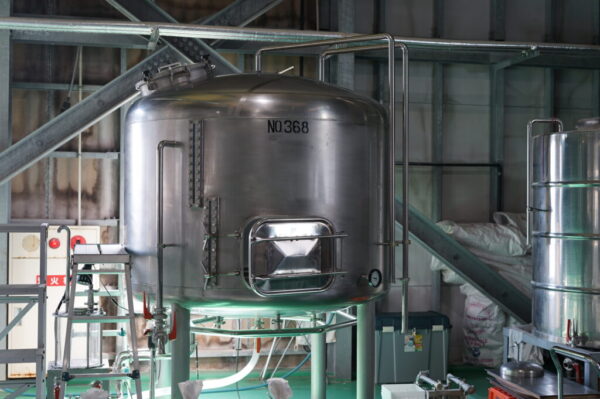
Mash tun made by a local contractor
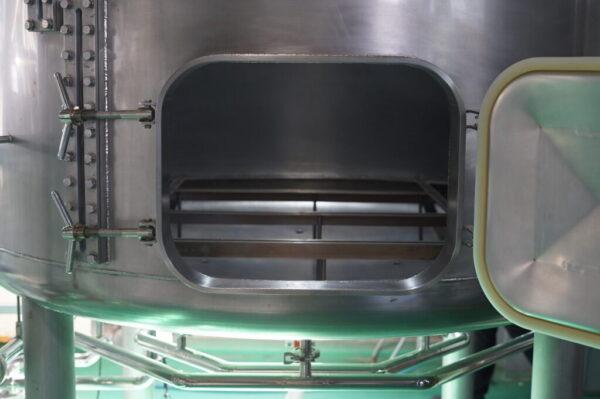
No automatic rake; stirring is done by hand.
The ‘time’ spent on the fermentation process is said to be excessive.
The most symbolic aspect of Suzaki Distillery is the length of its fermentation period.
Fermentation lasts 144 hours (6-7 days ). This is exceptionally long among domestic distilleries, likely the longest.
This extended fermentation aims to achieve complete lactic acid fermentation.
While other distilleries sometimes call it “excessive,” they still refuse to shorten this time.
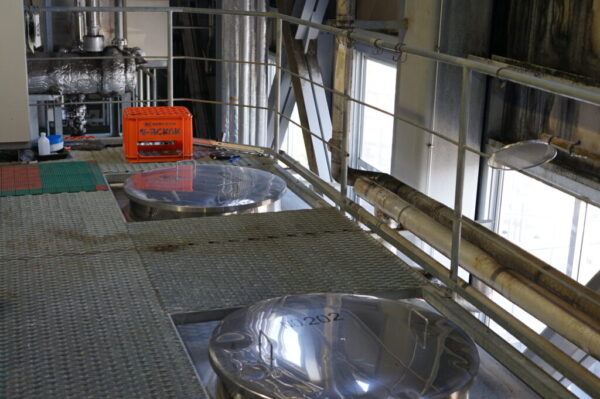
The fermentation tanks are made of stainless steel.
A cooling water management system is installed to control temperatures, preventing them from rising excessively even under Okinawa’s climate.
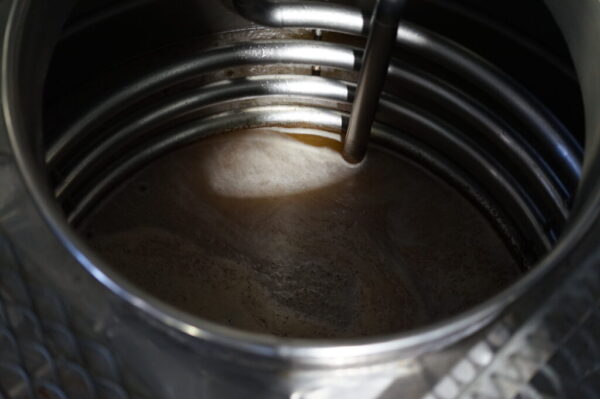
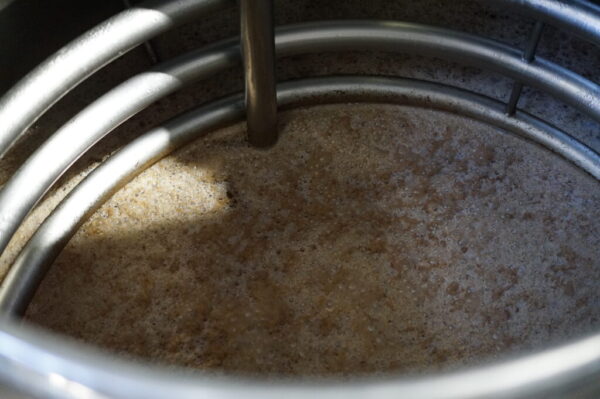
During the tour, we observed the mash on the third and fifth days.
The aroma carried a gentle quality, yet inside, fermentation was steadily progressing, clearly conveying the dedication to the mash.
 |
 |
 |
Distillation Process: Trial and Error and Next-Generation Distillation Equipment
There are five stills in total.
Two are for awamori, one is a vacuum still, and the remaining two are first and second distillation stills made by Italy’s Frilli, introduced specifically for whisky.
In the early days of whisky production, we used distillers that were also employed for awamori, but we couldn’t completely eliminate sulfur odors.
Subsequent trial and error involved combining copper plates, copper mesh, and copper wool within the pipes to remove off-flavors as much as possible.
The “Single Malt Ryuka” currently released uses the very spirit from that era.
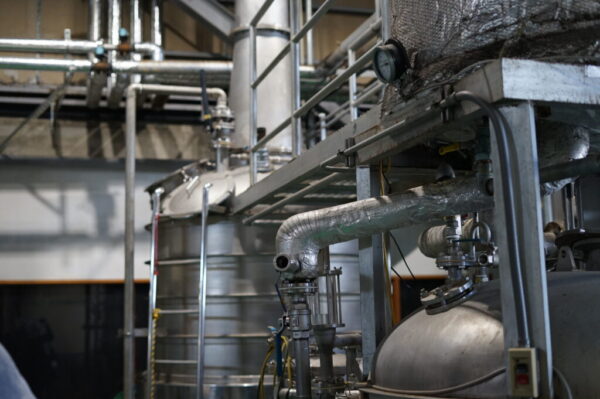
Stainless steel distillation apparatus also used for whisky production
The Italian Furilli stills, fully operational since 2023,
The first still is called “Teech,” meaning “1” in the Okinawa dialect. It is a 2000L straight-type still.
The re-distillation still is Taachi (meaning “2”). A 1000L bulb-shaped still. The re-distillation head is downward-facing.
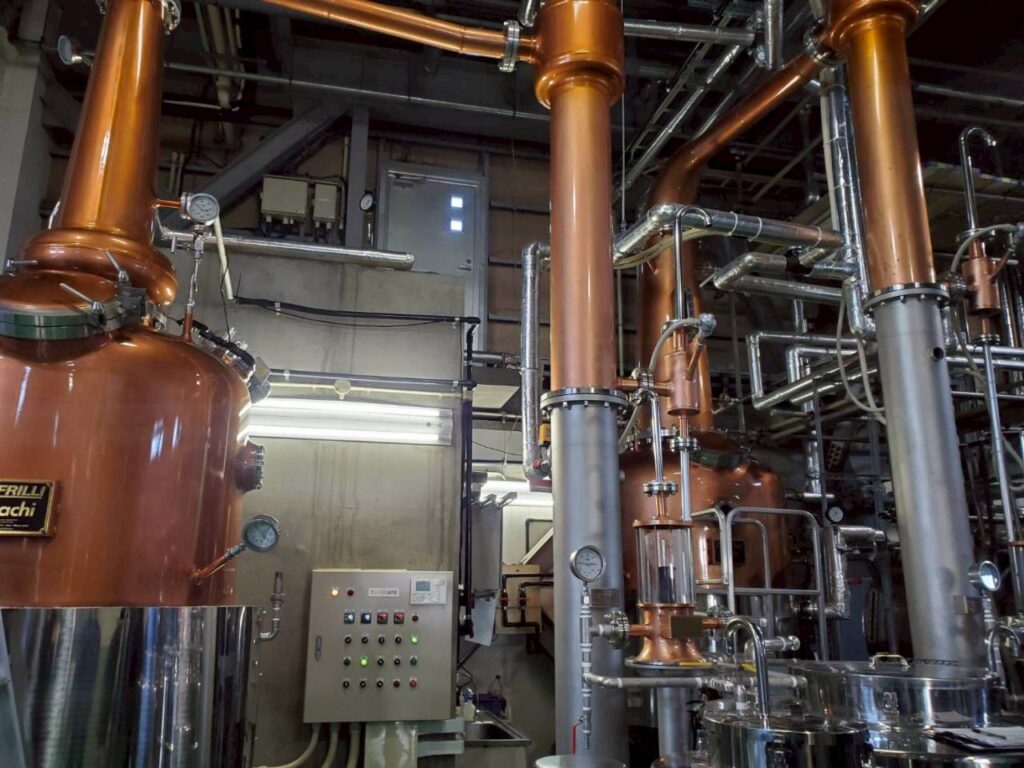
Right: Primary still (Taachi) Left: Secondary still (Tiich)
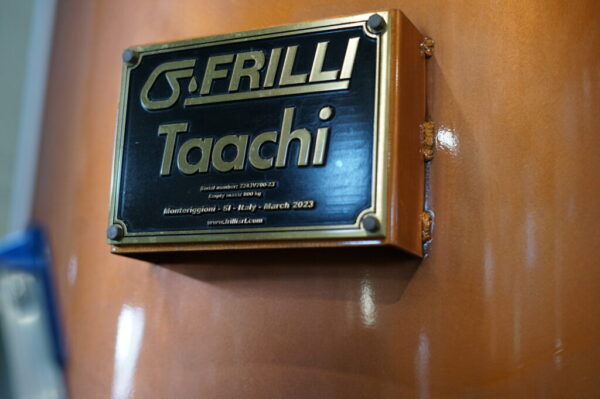 |
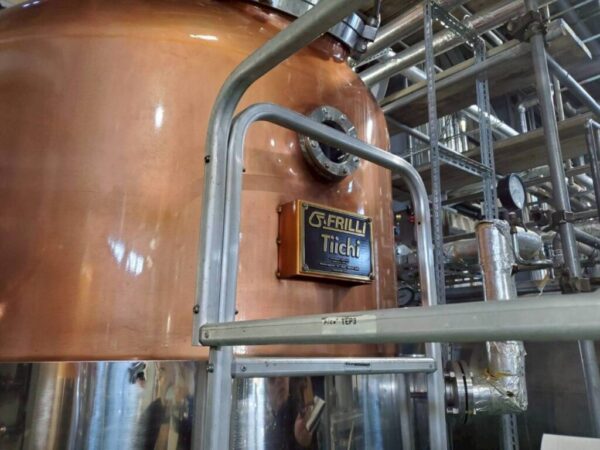 |
The first distillation is monitored through a window, boiled to the limit, agitated to create bubbles, and temperature-controlled. This is done to extract the various flavors contained in the mash by boiling at high temperatures.
During the second distillation, both the feints and low wines are cut based on alcohol content, with management conducted using both sensory evaluation and numerical data.
Aging: Angel’s Share 10% – Japan’s most beloved distillery by the angels
New make spirit from a 400kg batch of malt yields approximately 200 liters.
It is transported to the aging warehouse, located about a 5-minute drive from the distillery.
The building, once used as an awamori aging warehouse, has been renovated and is now utilized as a rack-style whisky aging warehouse.
Okinawa’s uniquely high average temperatures and significant daily temperature variations strongly accelerate the whisky’s maturation, bringing about distinct changes in color and flavor profile even at younger ages.
It is said that someone once remarked, “This must be the distillery most loved by angels in all of Japan, ” referring to the exceptionally high angel’s share.
True to those words, at Suzaki Distillery, the ‘losses’ incurred during aging are accepted as an inherent part of the process.
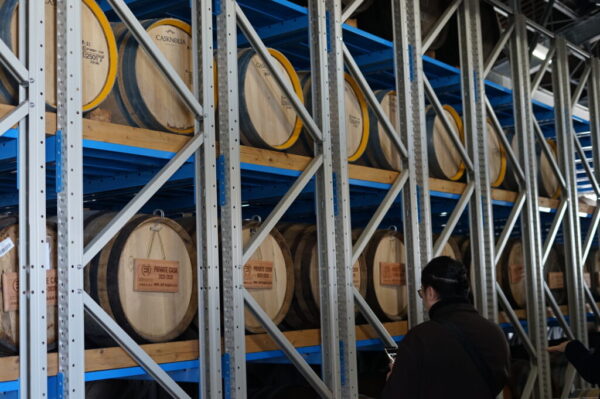
The barrels used are diverse, primarily consisting of bourbon barrels, sherry casks, and Spanish oak, but also including awamori barrels.
Private cask releases have already begun, and contracts are progressing.
The awamori barrels are new puncheon-sized casks that first mature awamori; after the awamori is drawn off, the whisky spirit is filled into them.
The flavor imparted by these maturation casks is said to possess a curiously similar nuance to that of bourbon casks.